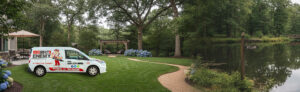

I’m Jeff, your local pest control guy.
If you’re standing in your yard in Topsfield, MA wondering, “Okay… but what if my neighbors don’t treat at all?” you’re not alone.
This question shows up when people are trying to live normal summer life.
Dinner on the deck.
A few friends over.
Kids running around until it gets dark.
Dog wandering the yard like he owns the place.
Then the mosquitoes start biting.
Or a tick shows up and the fun turns into worry.
Folks choose Topsfield, MA because being outside is part of what makes the town feel like home.
That might be a walk at the Ipswich River Wildlife Sanctuary, a ride through Bradley Palmer State Park, or a day at the Topsfield Fair with family and friends.
Your own yard should feel just as usable as those places.
So let’s answer the real question the way a homeowner needs it answered.
The honest answer in plain English
Yes—mosquito and tick control can still work even if your neighbors do nothing.
No—you’re not getting an invisible bubble around your property line.
Here’s how I explain this to homeowners.
A good program makes your yard a harder place for mosquitoes and ticks to succeed.
Fewer mosquitoes rest near the spots where you sit and relax.
Less tick activity shows up in the edge zones where ticks wait for a ride.
More pressure gets put on the mosquito life stages that happen in and around water, so fewer new adults keep popping up.
That’s what “it works” actually means.
Comfort comes back.
Confidence comes back.
Outside time stops feeling like a gamble.
Why your neighbor can still affect your yard
Let’s be real about it.
Mosquitoes and ticks don’t understand property lines.
This is what actually matters in your yard: where they live, where they hide, and how they move.
Mosquitoes move… but many don’t move far
Some of the most common “backyard” mosquitoes stay closer than people think.
CDC notes that certain Aedes mosquitoes don’t fly long distances and may only travel a few blocks in their lifetime.
That’s one reason a strong yard program can make a real difference even when the street isn’t treating together.
Other mosquito species can travel farther, especially with wind or wide open habitat.
A neighbor’s neglected pool, buckets, bird baths, or anything holding water can definitely add pressure to the area.
Even so, most biting problems still come from nearby breeding and nearby resting space.
Ticks don’t fly at all
Ticks hitchhike.
Deer move them.
Mice and chipmunks move them.
Pets can bring them right to the back door.
That’s why a neighbor’s brushy edge, stone wall, or unmanaged border can affect the whole neighborhood.
Risk still drops when your own edge zones are treated and your yard setup is less tick-friendly.
What “good control” looks like when neighbors don’t participate
When a homeowner tells me, “Jeff, my neighbor is a mess,” I don’t judge anybody.
I focus on what you can control.
That’s where results come from.
Most disappointing programs do one thing: they chase adult mosquitoes in the air.
Real control happens when you treat the habitat—the places mosquitoes and ticks actually use.
If you want the simple overview of how we run programs for New England yards, start here: our Mosquito & Tick Control program.
The simple biology that explains everything
I’m not going to talk like a textbook.
I’m going to make this useful.
Mosquitoes need water early in life.
Ticks need shade and humidity for most of their life.
Once you see that, the neighbor question gets easier.
Mosquito life stages and what matters in your yard
Mosquitoes have four stages: egg, larva, pupa, adult.
Eggs and larvae are tied to water.
Pupae are also in water, and that stage is short.
Adults are the ones flying and biting around your patio.
Here’s the part most homeowners never get told.
Adult control can reduce bites fast.
Water breeding still creates the next wave if nothing interrupts it.
That’s why an integrated plan is such a big deal in New England neighborhoods.
Tick life stages and what matters for your family
Ticks have four stages too: egg, larva, nymph, adult.
Movement is the key difference.
Ticks don’t spread by flying.
Ticks spread by waiting in the right place and grabbing a host.
That’s why your edge zones matter so much—wood lines, leaf litter, stone walls, and shady borders.
If you want a deeper look at how we approach those areas, this explains it clearly: our Tick Control service.
How we make your yard less inviting
Homeowners don’t want a science lecture.
People want to know what changes in the yard.
So let’s talk cause and effect.
Barrier work targets where mosquitoes actually rest
Most mosquitoes aren’t hovering over your lawn all day.
Resting happens in shady, protected spots where the air stays still.
Shrubs and low trees.
Dense plantings.
Under decks.
Along foundations where shade sits.
A properly applied barrier targets those resting zones, which lowers the number of mosquitoes hanging near the places you live outside.
Egg and larvae work helps reduce the “next wave”
Neighbor problems usually mean one thing: new mosquitoes keep getting produced close by.
That’s why egg and larvae control matters in higher-pressure yards.
The goal is simple—reduce how many mosquitoes make it from water to flying adulthood.
If your yard backs up to moisture, wetlands, low spots, or you’ve got standing water pressure nearby, the add-on that helps most is Mosquito Egg & Larvae Control.
Tick work focuses on edge zones where ticks wait
Ticks aren’t evenly spread across a lawn.
Clustering happens where things stay cool and damp.
Leaf litter builds up there.
Wildlife travels there.
Treating those transition areas lowers risk where kids and pets actually move through the yard.
What you can do that makes everything work better
This isn’t about blaming anybody.
This is about stacking the odds in your favor.
Small moves beat mosquitoes and ticks faster than most people expect.
Do a once-a-week water walk
Once a week, take five minutes and dump anything holding water.
Flip toys.
Empty buckets.
Scrub the bird bath.
Check tarps, wheelbarrows, planters, and low spots along the driveway.
One forgotten container can produce a lot of mosquitoes over a season.
Keep roof runoff moving away from the house
Clogged gutters are one of the sneakiest “standing water” sources I see.
That gunk holds moisture, and it sits right over the areas people use most—front steps, patios, walkways, and doors.
A clean roof line helps water move the way it’s supposed to move.
Open up shade near patios and play areas
Still shade is mosquito comfort.
Heavy cover is tick comfort.
Trimming back thick vegetation around seating areas helps both problems at the same time.
Make the edge less welcoming
Leaf litter belongs deeper in the woods, not right where the lawn meets the trees.
Brush piles should be kept away from play zones.
A simple mulch or gravel strip between lawn and woods can help reduce how easily ticks move into high-traffic areas.
Keep pets protected
Yard control helps.
Vet-recommended tick prevention helps too.
Quick checks after outside time are still smart in New England.
Why this question comes up so often in Boxford, MA
About a third of the way through this topic, someone usually says, “Jeff… my yard is basically the woods.”
That’s why this comes up a lot in Boxford, MA.
Boxford has big, beautiful wooded lots.
Outdoor life is a real thing there.
Boxford State Forest is a local favorite.
Baldpate Pond draws people for fishing and quiet time.
The Holyoke-French House area is one of those reminders that New England has deep roots.
Those same woods-and-water features also support mosquito and tick habitat.
So when neighbors don’t treat in Boxford, MA, the right plan focuses on two things at once.
Resting zones get treated so adult mosquitoes don’t pile up near your patio.
Edge zones get treated so ticks have a harder time showing up where your family walks and plays.
What changes the outcome when a neighbor has a “mosquito factory”
Sometimes the neighbor problem is obvious.
Standing water is everywhere.
A pool sits unmanaged.
A tarp holds water after every storm.
Projects and containers collect water all summer.
Your yard can still feel better because we reduce resting and biting on your property.
Better results show up when hatch pressure is reduced too.
That’s where egg and larvae work helps most, because you’re not only reacting to adults that fly in.
Fewer new adults means fewer new bites between visits.
Why this question hits hard in Andover, MA
Now let’s talk about Andover, MA.
Andover is a town where people use their outdoor spaces.
Pomps Pond turns into a summer magnet.
Harold Parker State Forest is a go-to for trails and getting away from the noise.
Ward Reservation is one of those places that makes you forget you’re close to busy roads.
That mix is great for people.
The same mix can be tough for mosquitoes and ticks—water nearby, woods nearby, and steady wildlife movement.
So the “neighbors do nothing” question in Andover, MA is often a “the whole area stays active” question.
A smart plan still works because it focuses on the right zones and keeps pressure on the problem all season.
What actually makes a neighborhood yard feel better
Here’s what I see again and again.
The yards that feel the best usually do three things consistently.
Habitat gets treated, not just air.
Standing water gets reduced weekly.
Scheduling stays steady through the season.
Simple beats complicated.
Consistency beats “one and done.”
So… how far does the problem travel, really?
This is where homeowners get stuck.
They think, “If mosquitoes can fly in from anywhere, why bother?”
That’s the wrong frame.
Many neighborhood mosquitoes stay close to home.
CDC points out that certain Aedes mosquitoes may only travel a few blocks.
EPA also notes that some salt marsh mosquitoes can travel long distances in certain conditions, which is why the bigger environment matters too.
The practical takeaway is straightforward.
Local breeding matters a lot.
Local resting space matters a lot.
So your yard can improve even if your neighbor never lifts a finger.
Why this question is also big in North Andover, MA
About two-thirds of the way through this topic, I want to bring up North Andover, MA.
North Andover has a mix that’s beautiful and challenging at the same time.
Stevens-Coolidge House & Gardens is a classic summer stop.
Weir Hill looks out over Lake Cochichewick and gets people outside fast.
The town common area has that “slow down a minute” feel that a lot of folks love.
Gardens, water views, and wooded edges are exactly where mosquito and tick pressure can stay steady.
Your yard still gets better when resting zones are treated and edges are handled correctly.
That matters even more when kids and pets use the same path to the play set every day.
Safety: the part you deserve to understand
“Is it safe?” is one of the top questions I hear from families.
That’s a fair question.
Here’s how I explain it in plain English.
We use products meant to be used outdoors, and we apply them the way they’re designed to be applied.
Label directions get followed, because the label is the law.
Targeted application is the goal, not careless blanket spraying.
If you want solid public resources, Massachusetts has a clear overview page on mosquito control and spraying.
CDC also has practical prevention guidance for ticks and tick-borne disease, and Massachusetts has tick-borne disease prevention guidance that’s written for everyday life.
EPA has pesticide safety tips that are easy to understand too.
At the yard level, the family rule is simple.
Keep kids and pets out of treated areas until the application is dry.
Dry time is often around 30 minutes, and weather can extend that.
Cool shade and damp conditions slow drying.
When in doubt, give it more time and you’re doing the smart thing.
What to expect after the first one or two treatments
Most homeowners feel a noticeable change quickly.
Outside time stops feeling like you’re volunteering to be bitten.
That said, week-to-week experience can bounce around for normal reasons.
Heavy rain can reduce what sits on leaf surfaces.
Heat can speed up mosquito development in standing water.
Neighbor breeding sources can keep “re-seeding” the area.
A steady program matters because it keeps pressure on the problem instead of letting it reset.
Think of it like staying ahead of weeds.
One mow helps.
Regular mowing changes the yard.
The season-long approach is what keeps you from constantly starting over.
Why Haverhill, MA homeowners ask this too
Near the end here, let’s talk about Haverhill, MA.
Haverhill has a lot of outdoor life packed into one city.
Winnekenni Park and Kenoza Lake are a local favorite for trails and scenery.
Riverside Park and Trail is another easy win when the weather finally cooperates.
The Bradford Rail Trail along the Merrimack River is the kind of walk that feels like a mini reset.
Water plus heat plus shade plus wildlife movement can keep mosquito and tick pressure steady in Haverhill, MA.
A good plan still works because the goal is reduction where your family actually lives outside.
FAQ
Q: Will treatments still help if my neighbor has standing water?
A: Yes, your yard can still improve because treated resting zones reduce biting pressure on your property. Better results show up when you also remove or manage the water sources you control.
Details: Mosquitoes lay eggs in or near water, so weekly water cleanup matters. Neighbor water can add pressure, but your yard can still become a less comfortable place for mosquitoes to hang out. Consistent scheduling keeps that advantage working for you.
Q: How far can mosquitoes come from, and does that make treatment pointless?
A: Many common neighborhood mosquitoes stay close to where they hatch, and CDC notes some Aedes mosquitoes may only travel a few blocks. Other species can travel farther, but local breeding and local resting space still drive most backyard biting.
Details: Shade, humidity, and nearby water create “mosquito comfort.” Habitat-focused treatments reduce how many mosquitoes rest near your patio and doors. That’s why homeowners often feel real relief even when the street isn’t treating together.
Q: Why am I getting hit hard in my yard but my neighbor seems fine?
A: Small yard differences matter more than most people realize, like shade, wind, and hidden water containers. One property can be a perfect resting spot while the other stays sunny and breezy.
Details: Dense shrubs, damp corners, and sheltered patios create better mosquito resting space. Moist edges and leaf litter create better tick space. A few simple yard changes plus the right treatment zones usually shifts the experience fast.
Q: Do I need mosquito egg and larvae control, or is a barrier treatment enough?
A: Many homeowners do well with a strong barrier program, especially on lighter-pressure lots. Higher-pressure yards often benefit when egg and larvae work reduces the next hatch.
Details: Adult control helps today, while larvae control helps next week. That combination matters most near wetlands, heavy shade, or stubborn standing water pressure nearby. The goal is fewer new mosquitoes showing up between visits.
Q: Is mosquito and tick spraying safe for kids and pets?
A: When products are used correctly and label directions are followed, families can use their yard again after the application dries. Dry time is often around 30 minutes, and weather can extend that.
Details: EPA and public health guidance consistently points back to label-following and smart handling. Keeping kids, pets, and toys out until dry is the simple rule that covers most concerns. A quick yard walkthrough can also help you feel confident about where and how everything is applied.
Q: What happens if it rains right after my treatment?
A: Light rain usually isn’t a big issue once the application has dried. Heavy rain soon after can reduce performance on leaf surfaces, which is why consistency through the season matters.
Details: Rain also creates new breeding water, and heat can speed up mosquito development. If you see a quick rebound, it often points back to water sources producing new adults. Weekly water cleanup and egg/larvae control helps most in those situations.
Q: Will tick control help if deer are walking through my yard?
A: Tick control helps reduce ticks in the areas where people and pets actually move, especially along edges. Deer can still bring ticks into the area, so the goal is lowering your risk where it matters most.
Details: Keeping brush and leaf litter down helps. Creating separation between lawn and woods helps too. Pairing yard work with pet prevention and tick checks is the calm, practical New England approach.
The bottom line
Your neighbor doesn’t have to cooperate for you to make progress.
A plan that matches mosquito and tick behavior is what changes the feel of your yard.
Resting zones get handled.
Edge zones get handled.
Consistency keeps the pressure on the problem all season.
Prefer to talk to a real person?
Call us at 888-229-0095 and we’ll get you setup
email: jeff@mosquitoenemy.com
“It’s More Fun Outside”! with Mosquito Enemy.