
The Micro-Habitat Truth From a Local Yard Guy
Let me guess.
You step outside.
Two minutes later you’re swatting.
Meanwhile your neighbor is sitting out there like it’s a perfect summer night.
If you’re standing in your yard wondering why this is happening, you’re not crazy. And you’re not alone.
I’m Jeff your local pest control guy, and I look at mosquito and tick problems the same way I look at any pest problem: what’s the environment doing, and why?
And if you’re in Amesbury, MA, you’ve probably seen this exact thing on your street. One yard gets hammered. The next yard feels almost normal. Same weather. Same neighborhood. Different bite level.
Here’s the truth in plain English:
Mosquitoes don’t use your yard evenly. They use it like a map. They pick the shady corners. They pick the damp pockets. They pick the quiet spots where wind can’t reach them. Then they rest there so they don’t dry out.
That’s what I mean by micro-habitat.
Micro-habitat is just a simple way to say: the small, easy-to-miss conditions in your yard that make mosquitoes comfortable. Shade. Moisture. Still air. Hidden water. Those four things decide a lot.
So in this article, I’m going to walk you through what actually matters in your yard. Not gimmicks. Not guesswork. Just cause and effect, explained like a homeowner would want it explained.
The biggest misconception: “Mosquitoes come from everywhere”
A lot of people picture mosquitoes like this:
“They’re just out there… floating around… and they show up when the weather is bad.”
That idea sounds logical. However, it’s not how mosquito pressure usually works in real neighborhoods.
Most mosquito species are not long-distance flyers. Many stay fairly close to where they hatch. On top of that, mosquitoes dry out easily, so they spend a lot of time hiding and resting during the day.
To grow and stick around, they need three basics:
-
Water to start life
-
Shade and humidity to survive the day
-
People and animals to feed and reproduce
Once you see it that way, the “why me?” question gets clearer.
Your problem usually isn’t the whole neighborhood.
Most of the time, the problem is a handful of little zones in your yard acting like a safe house.
And your neighbor’s yard might not have those zones.
The micro-habitat truth: small yard differences create big bite differences
Micro-habitat is not a science project.
It’s simply the truth that small yard details can create a totally different experience.
Here are the kinds of details that matter:
-
One corner of the yard stays shady and damp
-
A hedge blocks wind and traps humidity
-
A low spot holds water after rain
-
A downspout dumps water into a hidden pocket
-
Leaf litter and brush collect along an edge line
When those things stack up, mosquitoes don’t just “visit.”
They settle in.
Micro-habitat rule #1: Shade is mosquito shelter
If you remember one thing from this article, remember this:
Mosquitoes hate sun and wind. Shade and still air help them survive.
During the hottest part of the day, mosquitoes aren’t usually hunting you across the lawn. They’re resting. They tuck themselves under leaves, inside thick shrubs, under decks, and in shaded corners where the air stays humid.
That’s exactly why one yard can be brutal and the yard next door feels quiet.
What shade looks like in real yards
In real neighborhoods, these are the most common mosquito “rest stops” I see:
-
Dense shrubs along a property line
-
The shady side of the house that stays cool
-
Under a deck, especially when there’s storage underneath
-
A shaded corner behind a shed that never dries out
-
Stone walls with brush and leaf litter tucked in
Now compare that to a yard with more open lawn, more direct sun, and less thick planting. Better airflow makes it harder for mosquitoes to rest and survive.
The “green wall” effect
Privacy plantings can be beautiful.
At the same time, thick hedges often block wind.
When wind can’t move through, humidity builds up. Then damp air sits in place. That extra humidity helps mosquitoes live longer, which means you get more bites even if the breeding spots are small.
Micro-habitat rule #2: Moisture is the hidden engine
Most homeowners know mosquitoes start life in water.
What gets missed is the moisture part that happens after water.
A yard can have “no standing water” and still stay damp enough to support mosquitoes, because adult mosquitoes love humid resting zones. Damp shade is like an air-conditioned room for them.
The damp pocket problem
Low spots and soggy areas act like mosquito support zones, even when you never see a “pond.”
Common causes include:
-
Compacted soil that holds water after rain
-
A poorly draining corner where downspouts dump water
-
A soggy edge near woods
-
A shaded lawn area that never fully dries
Even without obvious standing water, damp shaded soil keeps the air humid near the ground. That humidity helps mosquitoes rest and survive between meals.
Why gutters and runoff matter more than people think
Overflow and drip zones create moist pockets that last for days.
Clogged gutters don’t just cause house problems. They create yard problems too. Water lands in a shaded corner, the ground stays damp, and mosquitoes get a reliable resting zone.
If you’ve ever said, “We don’t have water in the yard,” but you also have areas that stay wet for days, those two things don’t match. Moisture is water’s cousin, and mosquitoes treat it the same way.
Micro-habitat rule #3: Hidden water beats obvious water
Most people dump the obvious stuff:
-
Buckets
-
Toys
-
Birdbaths
-
Wheelbarrows
That helps.
Still, the mosquito problems that linger usually come from water homeowners don’t notice.
Common hidden breeding spots I see all the time
These show up again and again:
-
Corrugated downspout extensions holding water in the grooves
-
Flower pots with trays underneath
-
Tarps that sag and trap rainwater
-
Clogged yard drains
-
Kids’ play equipment with hollow legs
-
Grill covers that puddle at the low point
-
Recycling bins without drainage holes
-
The liner edge of an above-ground pool where water collects
Here’s the simple truth: you don’t need a pond to make mosquitoes.
You need a cup.
Sometimes you need less than that.
So when someone tells me, “Jeff, I have no water,” I usually say, “Let’s take a slow walk and look for the water you don’t notice.”
Micro-habitat rule #4: Wind is nature’s mosquito control
Airflow is a quiet hero.
Mosquitoes don’t like steady wind. Wind throws off their flight, and it dries them out. Because of that, a breezy yard often feels better than a still yard, even if both yards have some moisture.
Why your yard might have less airflow
Several yard layouts block wind:
-
Dense shrubs and trees
-
Fences close to thick plantings
-
House placement that creates a sheltered corner
-
Lower elevation pockets where air sits
If you walk into your backyard and barely feel a breeze, mosquitoes notice that too. Those still pockets are where they rest and build pressure.
Mosquito biology in plain English: why the problem ramps up fast
If you understand mosquito biology, mosquito control starts making more sense.
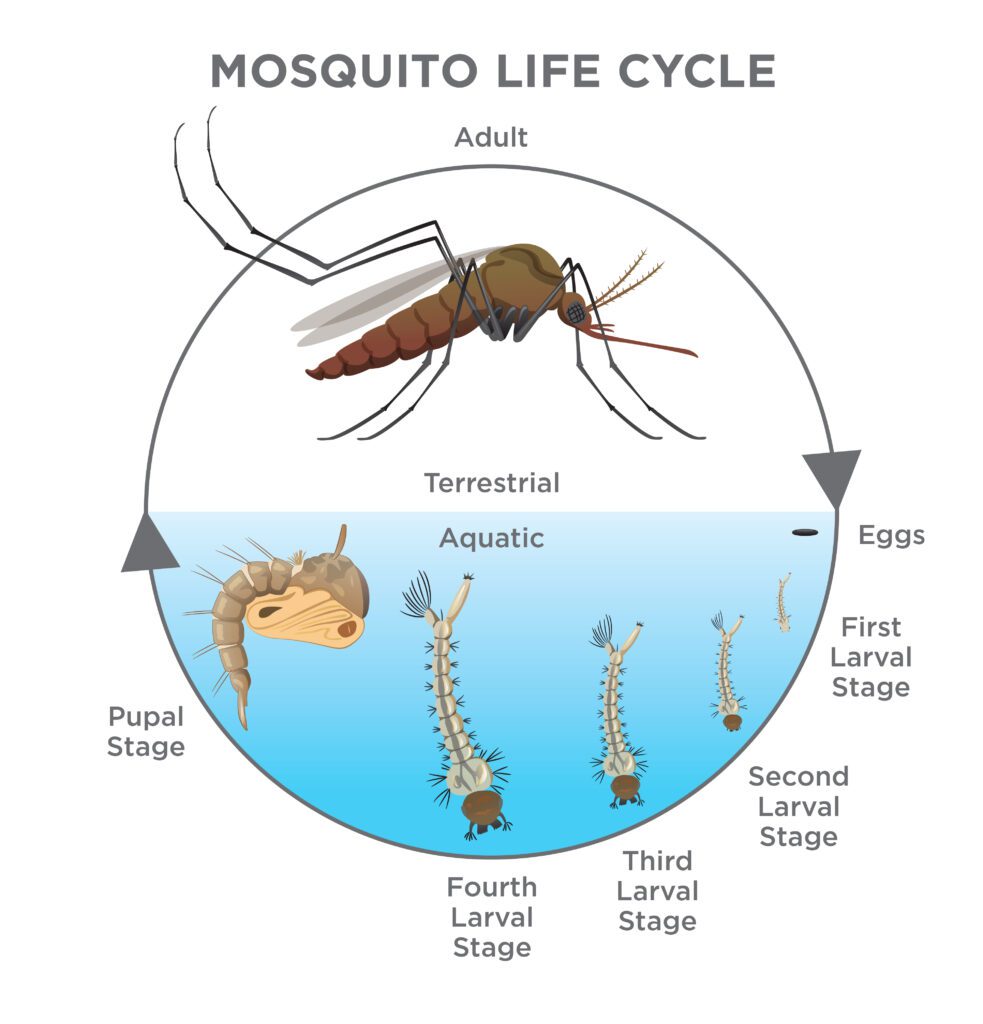
A mosquito has four life stages:
-
Egg
-
Larva
-
Pupa
-
Adult
Eggs and larvae live in water. Pupae also live in water. Adults fly and bite.
Warm weather plus water creates a fast ramp-up. After that, adults use shade and moisture to survive between meals.
Why “one spray” doesn’t fix the season
A lot of homeowners try a DIY spray, a fogger, a gadget, or a one-time treatment before a party.
Sometimes you feel a quick improvement.
Then the problem comes back.
That’s because your yard isn’t a one-time event. It’s a living environment. As long as eggs and larvae keep hatching, adults keep showing up.
That’s why a consistent plan works better than random one-offs. The goal isn’t just knocking down what you see today. The goal is staying in front of the next hatch cycle.
Now let’s talk ticks, because “mosquito yards” are often “tick yards”
In a lot of New England properties, mosquito-friendly conditions overlap with tick-friendly conditions.
Ticks don’t fly.
They wait.
And they like:
-
Tall grass
-
Brushy edges
-
Leaf litter
-
Damp shade
-
Stone walls
-
The border between lawn and woods
So if your yard has thick shade, moisture, and messy edges that don’t get cleaned up, you can have both problems even if mosquitoes get your attention first.
This is especially important for families with kids and dogs. Ticks are not just gross. They can be dangerous.
If you’re in a town like West Newbury, MA, woods-edge properties are common. That border zone is where ticks thrive, and it’s also where mosquitoes find cooler shade and humidity. One edge line can drive the whole season.
Why your neighbor might be fine, even if they do nothing
This part surprises people.
Sometimes the neighbor really is doing nothing.
But their yard conditions are working against mosquitoes.
Here are a few common “neighbor advantages.”
They get more sun
Sun dries things out.
Dry air is hard on mosquitoes.
Dry soil reduces breeding pockets.
They have better drainage
Their yard might slope better or have fewer low spots.
They have less dense landscaping
Fewer thick shrubs means fewer resting zones.
They have more airflow
Even a small breeze makes a big difference.
They don’t have the same hidden water sources
Downspouts might drain differently. Containers might be different. Gutters might be running clean.
So when you compare yards, don’t just look at lawn size.
Look at:
-
Shade
-
Dampness
-
Wind
-
Hidden water
-
Thick plantings
-
Edges against woods
That’s where the answer usually lives.
What I look for when I walk a property
When someone says, “Jeff, my yard is the bad yard,” I don’t stand there staring into the air.
I look for habitat.
Step 1: Find the resting zones
First, I look for shade and protection:
-
Under decks
-
Under low branches
-
Behind shrubs
-
Around dense hedges
-
Along the shady side of the house
-
Near the woods line
If a spot is shaded and still, mosquitoes can use it like a day-time shelter.
Step 2: Find the water sources, especially the sneaky ones
Next, I look for anything that holds water for more than a few days.
Then I watch how water moves after rain:
-
Where downspouts discharge
-
Where the yard stays wet
-
Where puddles form
-
Where drainage is blocked
Usually, the “mystery” is hiding in plain sight.
Step 3: Check the edges for ticks
After that, I check the borders.
Ticks live on the edges and travel lanes:
-
Woods edge
-
Stone wall
-
Tall grass line
-
Brushy corners
-
Leaf litter build-up
This is why “mow the lawn” is not a tick plan. It helps, but it’s only one piece.
If you live near coastal and marshy zones like Salisbury, MA, conditions can change quickly after rain and heat. Some weeks feel quiet, and then pressure spikes fast. In those situations, the yard needs a plan that keeps up.
What you can do today without buying anything
If you want quick wins, do these.
1) Open up airflow where you can
You don’t have to remove everything.
Even light thinning helps:
-
Trim lower branches so air can move
-
Thin a “green wall” so wind passes through a little
-
Clear brush in deep shade pockets
A little airflow goes a long way.
2) Do a weekly water check that takes 10 minutes
Once a week, walk the yard and look for anything holding water.
Don’t just check obvious containers. Look for the sneaky stuff.
If it holds water for 4–7 days, it matters.
3) Fix the downspout problem
Get water away from the house and away from shaded corners.
If a downspout dumps into a damp pocket behind shrubs, you’ve got a mosquito support zone.
4) Clean up the edges
Ticks and mosquitoes both like messy edge zones.
Clear leaf litter. Cut back brush. Keep the border tidy.
That won’t make you tick-proof, but it does reduce habitat and it makes the yard less attractive.
Why professional mosquito control works when it’s done right
Now let’s talk about real control.
Not hype. Not magic.
Just cause and effect.
A professional barrier treatment works because it targets where mosquitoes actually live.
Mosquitoes don’t spend their day hovering in the middle of the lawn.
They land.
They rest.
They hide.
So the key is treating shaded foliage and resting areas. When mosquitoes land there, they pick up the treatment and die.
That’s the logic behind a season-long plan like our mosquito and tick barrier treatment program: it focuses on the places mosquitoes and ticks actually use, not random spraying in the open.
Here’s the full program details: Mosquito & Tick Control.
If you’re searching “mosquito control near me” or “tick control near me,” what you really want is a plan that matches how these pests behave in real yards.
Why egg and larvae control is the missing piece for many yards
Most companies focus on adult mosquitoes only.
Adults are what bite, so that makes sense.
But in many yards, the real engine is breeding nearby.
Here’s how I explain it:
If you only treat adults, you’re always reacting.
If you also target breeding areas, you start getting ahead of it.
That’s exactly why we offer mosquito egg and larvae control as an add-on. It’s designed to help reduce breeding in standing-water zones so fewer new mosquitoes are hatching between visits.
Here’s that program: Mosquito Egg & Larvae Control.
One quick truth, because I like plain talk: pupae do not feed. That stage is basically a transformation stage. So the best practical win comes from going after eggs and larvae where they live.
How this plays out in real local yards
Let’s keep this local, because yard conditions change town to town.
In Newbury, MA, I see a lot of beautiful landscaping that creates privacy. That’s a great feature for homeowners. Still, thick plantings and blocked airflow can also create the exact “cool, still, humid” environment mosquitoes love. When that happens, the yard can feel worse than the neighbor’s even though both properties look well kept.
Over in Merrimac, MA, drainage and edges often decide the season. One low spot behind a shed, one gutter overflow zone, or one brushy border can be the difference between “annoying” and “we can’t use our yard.”
The common thread is always the same: shade, moisture, still air, and hidden water.
Once you identify those four things, the problem stops feeling random.
Homeowner questions I hear constantly, and my calm answers
Do mosquitoes live in the grass?
Not usually.
Grass can hold moisture, but heavy mosquito resting zones are usually shrubs, low trees, brush, and shaded corners.
If my neighbor has standing water, am I doomed?
No.
It can add pressure, sure. However, your yard conditions still decide whether mosquitoes settle in and stick around. A sunny, breezy yard often does better even when someone nearby is sloppy.
What about traps and gadgets?
Some traps help in limited ways, especially in small zones.
Still, gadgets don’t fix the core habitat problem. If your yard is a perfect resting zone with hidden water, mosquitoes will keep showing up.
Why do I get bitten more than my spouse?
That’s real.
Mosquitoes respond to body heat, carbon dioxide, sweat chemistry, and movement. Two people can stand in the same yard and have different experiences.
What time of day is worst?
Often early morning and dusk.
But in shaded, humid yards, mosquitoes can bite throughout the day, especially in deep shade zones.
If you treat my yard, do I have to do anything?
You don’t have to become a full-time mosquito manager.
That said, removing easy water sources and opening airflow in problem spots usually improves results. Think of it like teamwork: we bring the control, and you remove the easy fuel.
The simplest way to think about this
If you want the one-sentence answer to “why my yard and not my neighbor’s,” here it is:
Mosquitoes are worse in the yard that has more shade, more moisture, more still air, and more hidden water.
And ticks are worse in the yard that has more brushy edges, more leaf litter, more damp shade, and more wildlife traffic.
That’s the micro-habitat truth.
What you should do if you want your yard back
If you’re a homeowner with kids, pets, cookouts, and a short New England summer, you don’t want to spend your best months inside.
You want to step outside and feel normal.
No swatting.
No panic.
No “we’re going in.”
So here’s the plan I recommend, calmly and realistically:
-
Reduce hidden water sources that keep producing mosquitoes.
-
Open up airflow in the worst shade pockets.
-
Clean up edges and leaf litter that support ticks and damp zones.
-
Use a consistent mosquito and tick plan that targets where these pests actually live.
-
If mosquitoes keep rebounding, add egg and larvae control so you’re not only reacting to adults.
That’s how you go from “my yard is the bad yard” to “we can actually use this place.”
A final word from me, the local yard guy
I’m not here to scare you.
I’m here to help you understand what’s happening.
Because once you understand the why, the fix becomes clear.
And when the fix is clear, you stop wasting time on stuff that doesn’t move the needle.
Call to Action
Get Your Free Quote
Call: 888-229-0095
Email: jeff@mosquitoenemy.com