
Hey, I’m Jeff, your local pest control guy.
If you’re asking how far do mosquitoes travel, you’re usually trying to solve a frustrating problem: you cleaned up your own standing water, but you’re still getting bitten.
The answer is that mosquito flight range depends heavily on the species. Some stay close to where they developed, while others can travel much farther. That means mosquitoes can travel from neighboring yards, nearby woods, drainage areas, wetlands, and other habitat into your property.
Quick answer: how far do mosquitoes travel?
Some common mosquitoes move only a few blocks, while others can travel a mile or more. CDC notes that Aedes aegypti and Aedes albopictus generally do not fly long distances and may stay within a few blocks during their lifetime. CDC also notes that some Culex mosquitoes have been known to fly up to about two miles.
That is why there is no honest single distance that applies to every mosquito in Massachusetts or New Hampshire.
Can mosquitoes really come from a neighbor’s yard?
Yes. Property lines mean nothing to a flying mosquito.
A neighboring yard with containers holding water, dense shade, unmanaged drainage, or protected resting habitat can contribute to pressure that moves onto your property. CDC’s current community mosquito-control guidance specifically emphasizes that homeowners, neighbors, and communities all play a role in reducing mosquitoes.
See the CDC guidance on mosquito control in a community.
Species matters more than homeowners realize
Different mosquitoes behave differently.
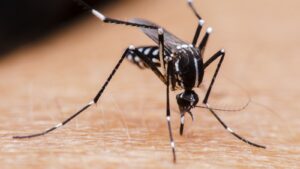
Aedes mosquitoes commonly stay closer to homes and container-breeding habitat. CDC says Aedes aegypti and Aedes albopictus typically fly only a few blocks.
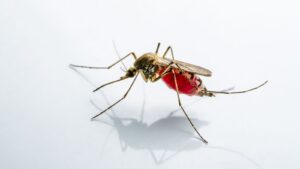
Culex mosquitoes can range farther. CDC reports that Culex mosquitoes do not usually fly long distances but have been known to travel up to about two miles.
You can review the CDC information on Culex mosquitoes and the Aedes mosquito life cycle and behavior.
Why your yard can still get hit after you remove standing water
Cleaning your own property still matters. It reduces the number of mosquitoes your yard can produce.
What it cannot do is control every breeding source around you. Water can sit behind a fence, in a neighboring gutter, in a drainage pocket, inside a container you cannot see, or on nearby land outside your control.
That is why a well-maintained property can still experience a mosquito wave after rain or during a period of heavy regional pressure.
What you can control on your own property
Start with the places mosquitoes can breed. CDC recommends emptying and scrubbing, turning over, covering, or discarding containers that hold water at least once a week.
- Dump water from toys, buckets, plant saucers, covers, and outdoor containers.
- Check gutters and drainage areas that remain wet.
- Correct irrigation that creates persistent puddles.
- Look for dense shaded vegetation close to patios, decks, and doors.
- Use properly labeled larval control where water cannot simply be dumped or drained.
Our guide to Mosquito Egg & Larvae Control explains how we handle water that keeps returning.
Why resting habitat matters even when mosquitoes hatch somewhere else
A mosquito may arrive from outside your property and then rest in the shade on your property before biting.
CDC notes that adult mosquitoes rest in dark, humid locations. Around a home, that can include protected vegetation and other shaded areas.
That is why a professional barrier program focuses on the places mosquitoes are likely to rest—not the middle of an open lawn.
Does one treatment stop mosquitoes from neighboring properties?
No treatment creates an invisible wall that prevents every mosquito from flying into a yard. A good program reduces mosquito pressure by treating the places mosquitoes use after they enter the property and by reducing breeding where possible.
Consistency matters because new mosquitoes can emerge or move in after an application. That is one reason recurring service generally provides steadier comfort than a one-time spray.
You can read more about our mosquito and tick control program.
When outside pressure is especially noticeable
Homeowners tend to notice outside pressure after warm rain, during humid stretches, near wetland or coastal habitat, and when neighboring properties contain a lot of shade or standing water.
Wind, temperature, species, local breeding conditions, and the amount of resting habitat all change what you experience on a particular night.
That variability is why I would rather explain the biology than promise that every mosquito stays within one fixed distance.
FAQ: mosquitoes traveling from neighboring yards
How far can mosquitoes travel from where they hatch?
It depends on the species. Some Aedes mosquitoes may stay within a few blocks, while CDC reports that some Culex mosquitoes have been known to travel up to about two miles.
Can my neighbor’s standing water affect my yard?
Yes. Mosquitoes that develop nearby can move across property lines and use resting habitat on your property.
If I remove all my standing water, why do I still have mosquitoes?
Because your yard is only one part of the surrounding habitat. Removing your own water reduces local breeding, but mosquitoes can still arrive from nearby sources.
Can a mosquito treatment stop mosquitoes from flying in?
No. The goal is to reduce the mosquitoes that rest and bite on your property and to reduce breeding sources where possible—not to create a physical barrier in the air.
What is the best thing I can do between treatments?
Keep removing standing water and watch the shaded resting zones around the areas you use most. Those two habits reduce the parts of mosquito pressure you can actually control.
Bottom line
How far mosquitoes travel depends on the species, but neighboring yards absolutely can contribute to the mosquitoes you experience. Some species stay close to home, while others move much farther.
Your own cleanup still matters because every breeding source you remove is one less source feeding the problem. When outside pressure stays high, consistent control of resting habitat and standing water gives you the best chance of keeping the yard comfortable.
If you want us to evaluate where pressure may be coming from, contact Mosquito Enemy or call/text 888-229-0095.
It’s More Fun Outside! with Mosquito Enemy.