
I’m Jeff, your local pest control guy.
Every summer I hear this one.
“Do I really need to worry about mosquito-borne illness in MA and New Hampshire?”
That question is smart.
Bugs are annoying.
Disease talk is a different category.
So let’s keep this calm, practical, and real.
I’ll tell you what actually happens in our area, what the risk maps mean, and what families can do that truly works.
Related reading
Start here: West Nile virus: How People Get It and When to Worry
Then read this: Eastern Equine Encephalitis (EEE): Symptoms, Risk, and Prevention
Quick answer
Yes, mosquito-borne illness can occur in Massachusetts and New Hampshire, but the risk is still low for most people most of the time.
West Nile virus and EEE are the two names you’ll hear most in MA, and New Hampshire tracks West Nile and EEE too, with Jamestown Canyon virus showing up in surveillance as well.
State risk maps are based on seasonal testing and local indicators, so “moderate” or “high” usually means officials are seeing enough evidence in mosquitoes, animals, or patterns to warn people and reduce pressure.
Town spraying does not automatically mean human cases are nearby.
Family protection is mostly bite prevention and yard pressure reduction, not panic.
Which mosquito-borne diseases actually occur in Massachusetts and NH?
In Massachusetts, the big two are West Nile virus and Eastern Equine Encephalitis.
In New Hampshire, West Nile and EEE are also part of the public health tracking.
Jamestown Canyon virus is another mosquito-borne virus that New Hampshire has identified through testing and reporting over the years.
Here’s the clean way to think about it.
Local transmission is possible in our region, but it’s not a guaranteed “everyone gets sick” situation.
Most people who get bitten never get ill.
Public health watches for these viruses because the serious cases matter, even when total numbers stay small.
Travel diseases are a separate bucket.
Dengue, malaria, and Zika are usually travel-related issues, not “New England backyard” issues, so keep those conversations tied to travel guidance, not local yard fear.
What’s the difference between “nuisance mosquitoes” and “disease-risk mosquitoes”?
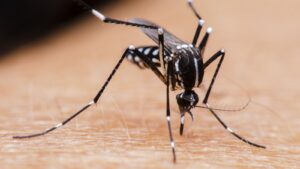
Not every mosquito is the same.
Some species are just miserable biters.
Other species are the ones health departments watch more closely because they’re linked to certain viruses.
Nuisance mosquitoes often show up as “my yard is unusable” mosquitoes.
Those are the ones that hammer ankles at dusk, or swarm after a rainy stretch, or live in the shade under the shrubs.
Disease-risk mosquitoes are more about the surveillance side.
Health teams track species, numbers, and virus results in mosquito samples, because certain species tend to show up more in the disease cycle for West Nile or EEE.
A yard can be loaded with nuisance mosquitoes and still have low disease risk that week.
Another yard can feel “not that bad,” while the region is seeing elevated risk signals in surveillance.
Comfort and disease risk overlap, but they are not identical twins.
What does “high risk” vs “moderate risk” mean on state risk maps?
Risk maps are not a crystal ball.
Those maps are a decision tool.
States use seasonal testing and surveillance to assign levels by town or region.
That info can include mosquito trapping results, positive mosquito samples, patterns, and other public health indicators.
“Moderate” generally means officials are seeing enough activity to say, “Pay attention and tighten up prevention.”
“High” or “very high” usually means stronger signals, more positives, and more reason to reduce exposure at peak hours.
None of those labels means you’re guaranteed to get sick.
Each label is really a message about odds and caution.
Higher risk means you treat dusk and dawn like “don’t mess around” time.
Lower risk means you still prevent bites, but the urgency is not the same.
Does mosquito spraying mean there are human cases nearby?
No, not automatically.
Spraying can happen because mosquito numbers are high.
Action can also happen because testing shows virus activity in mosquitoes, even before any human case is reported.
Public health tries to lower risk before people get sick.
That’s the whole point of surveillance.
When a town sprays that usually a sign that officials are responding to pressure or risk signals.
A spray is not proof that “someone on your street has it.”
If you want the real details, read the town notice.
Health departments often explain the reason, the timing, and the precautions in plain language.
When should a family take this more seriously?
Pay attention when the state raises your town’s risk level.
Listen harder when your local board of health starts issuing stronger guidance for evening hours.
Treat dusk and dawn like peak pressure time during elevated risk periods.
Older adults deserve extra caution.
Immune-compromised people deserve extra caution too.
Kids deserve extra protection because they forget bites until they’re scratching at midnight.
None of that is meant to scare you.
All of it is meant to keep your decisions smart.
What are the best bite-prevention steps that actually work for families?
Here’s the simple stack I trust.
Use repellent when you’re outside during peak mosquito time.
Wear light long sleeves when weather allows.
Run a fan on the patio.
Keep screens tight and doors closed.
Choose brighter, breezier spots for hangout time.
Avoid the shady, humid corners at dusk when mosquitoes come alive.
Handle the yard-side problem too.
Dump standing water.
Tip over what keeps refilling.
Clogged gutters can quietly hold wet debris and create breeding pockets without you noticing from the ground.
Trim dense shrubs where air never moves.
Airflow changes comfort more than most people expect.
What I watch for in “tough” MA/NH yards
Water creates refills.
Shade creates resting zones.
Neighboring pressure creates surprise comebacks.
Even just one untreated breeding pocket can repopulate a yard fast.
One thick hedge line can hold a whole bunch of resting mosquitoes.
A swampy edge nearby can keep pressure higher than a homeowner expects.
That’s why a plan beats a one-off spray.
Where Mosquito Enemy fits
Our Mosquito + Tick Programs focus on the places mosquitoes rest and the edges where pressure builds.
Consistency matters because refills happen between visits.
Breeding control steadies the tougher properties.
That’s why Mosquito Egg & Larvae Control exists as five targeted applications per year aimed at breeding zones.
Larvae feed, so larvicides can control them.
Pupae don’t feed, so that stage can’t be controlled the same way.
Stopping refills is how a yard gets steadier instead of swinging from good week to bad week.
Bottom line
Yes, mosquito-borne illness is something to be aware of in MA and New Hampshire.
No, you don’t need to live scared.
Risk maps are useful because they help you tighten habits at the right time.
Spray notices usually mean officials are managing pressure and risk signals, not announcing neighborhood panic.
A smart family plan is bite prevention plus yard pressure reduction.
That’s how you stay calm and still enjoy being outside.
FAQ
Which mosquito-borne diseases actually occur in Massachusetts and NH?
A: In Massachusetts, West Nile virus and EEE are the main mosquito-borne diseases public health tracks each season, and New Hampshire tracks West Nile and EEE as well.
Detail: New Hampshire also tracks Jamestown Canyon virus through mosquito testing, which is another reason bite prevention stays important.
What’s the difference between “nuisance mosquitoes” and “disease-risk mosquitoes”?
A: Nuisance mosquitoes are the heavy biters that make a yard unusable, while disease-risk mosquitoes are the species public health focuses on because they’re linked to virus cycles.
Detail: A yard can feel awful from nuisance mosquitoes even when disease risk is low, so comfort control and disease awareness are related but not the same.
What does “high risk” vs “moderate risk” mean when the state updates risk maps?
A: “Moderate” and “high” are surveillance-based risk levels that reflect testing results and local indicators for that season.
Detail: Higher risk levels usually mean stronger evidence of virus activity in the region and a stronger recommendation to reduce dusk and dawn exposure.
Does mosquito spraying mean there are human cases nearby?
A: Spraying does not automatically mean human cases are nearby, because many spray decisions are based on mosquito surveillance and risk reduction.
Detail: A spray notice does mean officials are seeing enough pressure or risk signals to take action, so it’s a good time to tighten bite prevention.
What are the best bite-prevention steps that actually work for families?
A: Use repellent at peak hours, wear light long sleeves when possible, run fans on patios, keep screens tight, and avoid shady humid corners at dusk.
Detail: Dumping standing water and maintaining gutters reduces breeding pressure, which reduces the number of bites you deal with in the first place.
Top towns we service
Here are 16 of the top towns we service every week.
Amesbury, MA
Andover, MA
Boxford, MA
Byfield, MA
Georgetown, MA
Groveland, MA
Haverhill, MA
Ipswich, MA
Merrimac, MA
Byfield, MA
Newburyport, MA
North Andover, MA
Rowley, MA
Salisbury, MA
Topsfield, MA
West Newbury, MA
Don’t see your town? We probably still service it. Use our Service Area page to confirm.
Related resources
Start with / Mosquito + Tick Programs
Add this for tougher yards / Mosquito Egg & Larvae Control
Ticks ONLY / Tick Control
Home protection / Home Shield
Stinging insects / Stinging Insect Control
Rodents / Rodent Control
Gutter Cleaning / Gutter Cleaning
Reach us / Contact us
Call or text: 888-229-0095 | Email: jeff@mosquitoenemy.com | Contact us
It’s More Fun Outside! with Mosquito Enemy.