Hey, I’m Jeff, your local pest control guy.
Understanding your dog’s backyard route helps connect everyday activity with tick exposure. One of the easiest ways to misunderstand a tick problem is to look only at the yard and forget to look at how the dog actually uses it.
Dogs create their own map: a worn track beside a fence, a cool hollow beneath shrubs, a path into the woods, or a route to a shed that the homeowner may barely notice anymore.
Those routes do not automatically change our treatment program, but they can tell us where people and pets are making repeated contact with tick habitat and where a technician needs to pay attention.
A Newbury Property Where the Dog Can Almost Disappear
I have a customer in Newbury, Massachusetts with a large property, heavy foliage, and a two-story deck behind the house.
Enormous shrubs grow beneath and around that deck, and the family’s older dog likes to settle into that cool protected area.
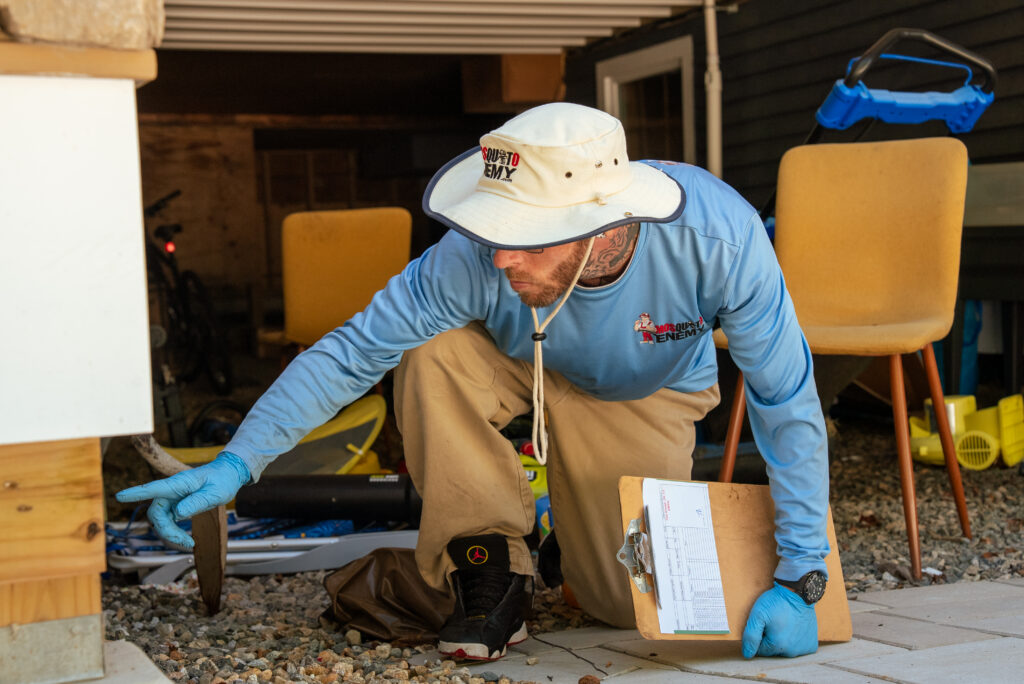
Sometimes the dog is so tucked under the shrubs that a technician could be working nearby and never see him unless he deliberately checks first.
Because of that, the account carries a specific note: look for the dog under the shrubs before treating that area.
If he is there, we skip the immediate area unless the dog can be safely moved; product never takes priority over the animal standing in the treatment zone.
That little note is a good example of why service records matter: a technician may only be on the property for a short visit, while the customer’s dog follows the same routine every day.
Your Dog’s Backyard Route Can Be More Useful Than a Guess
Customers will often tell me exactly where they believe the ticks are coming from, just as they will with mosquitoes.
Usually I listen, because their observations matter, but I do not assume the suspected source is automatically correct.
A worn trail through grass or leaves can show where the dog repeatedly travels even when nobody is standing outside watching the dog all day.
Instead of treating the dog’s route as proof of where every tick originated, I treat it as another field clue that helps connect habitat with actual exposure.
University of Maine Tick Lab guidance supports that way of thinking: ticks tend to be common in wooded, brushy, shaded, leaf-covered areas and along trails, while pets can be exposed simply because their outdoor activity brings them through those places.
When the Backyard Route Leads to a Shed
Another common backyard route is a narrow path that leaves the maintained yard and runs through vegetation to a shed.
The family may walk that path, the dog may use it every day, and the shed itself may sit in shade with leaf litter, brush, or open space underneath it.
When a customer tells us that route is important, we can write the instruction into the account so the technician knows it is part of the property’s normal use pattern.
On those properties, my field preference is to treat the appropriate labeled vegetation and ground-level habitat on both sides of the walkway, include the walkway where the label permits, and inspect the area around and under the shed rather than stopping at the edge of the lawn.
A customer I have in Rowley, Massachusetts believes he encountered a tick while he was inside his shed.
I cannot prove where that particular tick came from, because a tick found indoors may have been carried in on a person, a pet, a rodent, or another host.
Still, the concern is real enough that the shed is part of that customer’s service notes, and we inspect and treat appropriate labeled interior locations when conditions allow.
Inside a Shed Is a Label Question, Not a Blanket Rule
Here is an important distinction: I do not want a customer reading this and assuming every shed should be broadcast-sprayed from wall to wall.
The EPA-approved label for the product used on the property determines whether indoor tick treatment is allowed in a shed or other storage area.
However, the indoor directions call for appropriate crack-and-crevice, spot, pinstream, or coarse low-pressure applications to places where pests hide; they are not permission for an unrestricted indoor broadcast treatment.
Pets must be removed from the treatment area, and people and pets should not contact treated surfaces until the spray has dried.
For a shed, that means the actual site, how it is used, what is stored inside, and the product label control the decision every time.
A Treated Yard Does Not Follow the Dog Down the Street
The other lesson from dog routes is that property lines mean almost nothing to a dog.
A dog may slip into the neighbor’s yard, chase something into the woods, follow a trail well beyond the treated area, or wander around the neighborhood and come home carrying a tick.
That does not automatically mean the yard treatment failed, because our application only works on the property and labeled surfaces we actually treated.
Once the dog leaves that area, exposure depends on where the backyard route takes the animal next.
For that reason, I tell dog owners to think in layers: professional yard control, veterinarian-recommended tick prevention and regular pet checks, plus sensible attention to the routes the dog uses most.
CDC guidance recommends checking pets for ticks every day, especially after time outdoors, and specifically calls out areas such as the ears, eyelids, collar area, tail, legs, and between the toes.
Massachusetts public-health guidance likewise reminds homeowners that ticks are common in shady, damp, brushy, wooded, and grassy areas and that dogs, cats, deer, and mice can all serve as hosts.
How a Tick Ends Up on the Bed or Furniture
A homeowner may find a tick on the couch or in bed and assume it must have come from the center of the backyard.
What may have happened is much simpler: the dog traveled through brush or woods, picked up an unattached tick, came inside, and later transferred it to furniture or a person.
Finding the tick indoors does not tell us exactly where outdoors the encounter occurred, so I would rather examine the dog’s routine than pretend the last place the homeowner noticed the tick was the source.
That is also why pet prevention and tick checks remain important even for customers who receive professional yard treatments.
What to Tell Us About Your Dog’s Backyard Route
Useful information is practical, not scientific: where does the dog sleep outside, where does it go to the bathroom, which fence line does it patrol, and does it disappear down a trail or under a deck?
Mention a hidden shed, a kennel run, a shaded shrub pocket, a favorite resting spot, or a route into the woods so those details can be added to the account when they affect service.
If the dog is likely to be outside during treatment, that matters too, especially when the animal can hide under shrubs where a technician might not see it immediately.
Clear notes help the next technician understand the property before the hose is ever pulled from the truck.
Our broader explanation of how our mosquito and tick program works covers the inspection-and-treatment process, while our guide to tick control for wooded yards and dogs goes deeper into the exposure that can happen beyond the maintained lawn.
The Backyard Route Field-Note Takeaway
Following a dog’s backyard route is not about chasing every paw print with a sprayer.
It is about understanding where repeated contact happens, noticing the habitat around those routes, and making sure important instructions do not live only in the homeowner’s memory.
A hidden dog under shrubs, a path to a shed, or a worn opening into the woods can all change what a technician needs to notice without changing the basic standard of a thorough treatment.
Most importantly, the route can explain why a tick still shows up indoors even when the main yard has been professionally treated: the dog may have traveled somewhere the treatment never went.
Frequently Asked Questions About Backyard Tick Routes
Q: Why does a tick-control technician care where my dog walks in the yard?
A: Because repeated dog routes show where pet contact is happening. Worn paths near brush, woods, shaded shrubs, a fence line, or a shed can help the technician connect real use of the property with tick habitat instead of relying only on a map.
Q: What if my dog hides under shrubs during mosquito or tick treatment?
A: Tell the company before service and keep the dog out of the treatment area. If a technician finds the dog in a hidden resting spot, that immediate area should be skipped until the animal can be safely moved and the label conditions for treatment are met.
Q: Should a wooded path to my shed be included in tick treatment?
A: It can be important when people or pets regularly use that route and the surrounding habitat is appropriate for treatment. The technician should inspect the vegetation, leaf litter, edges, and shed area, then treat only the sites and surfaces allowed by the product label.
Q: Can a tick actually be found inside a shed?
A: Yes, a tick can be carried into a structure on a person, pet, rodent, or other host, so finding one inside is possible. That does not prove the tick originated in the shed, and any indoor pesticide application still has to follow the product’s indoor label directions.
Q: Can my dog bring a tick home even though my yard was treated?
A: Yes. Dogs can leave the treated property, enter woods or a neighbor’s yard, walk through brush elsewhere, and return with a tick, which is why veterinarian-recommended prevention and regular tick checks still matter.
Your Backyard Route, Tick Habitat, and a Better Treatment Plan
If your dog has a favorite route, hidden resting area, wooded path, or shed that your family uses regularly, tell us before the next service so the technician knows what matters on your property.
Call or text Mosquito Enemy at 888-229-0095 and we can help you think through the high-contact areas without pretending any yard can be made tick-proof.
You can also contact Mosquito Enemy or review our frequently asked questions for more practical guidance about mosquito and tick control in Massachusetts and New Hampshire.
It’s More Fun Outside! with Mosquito Enemy.