
I’m Jeff, your local pest control guy.
Mosquito control is changing.
Not because your backyard suddenly got easier.
Because science is throwing some new tools on the table.
You might hear phrases like Wolbachia mosquitoes or genetically modified mosquitoes.
That can sound like a movie plot.
Real life is simpler than that.
This blog breaks down what these biocontrol approaches are, what they’re designed to do, where they’re being tested, and what questions still need honest answers.
Related reading
Start here: What happens if it rains after a mosquito treatment?
Then read this: Mosquito Spray Schedule: Why Recurring Treatments Beat One-Time Sprays
Quick answer
Two newer biocontrol tools aim to reduce certain mosquito populations by releasing non-biting male mosquitoes that mate with wild females.
Wolbachia-infected male mosquitoes use a naturally occurring bacterium that makes eggs fail when the pairing is “incompatible,” so fewer young survive and the target population drops over time.
Genetically modified male mosquitoes carry a trait designed so female offspring don’t survive, which also drives the local target population down with repeated releases.
These tools are species-specific and currently focused mainly on Aedes mosquitoes, which are important disease vectors in certain parts of the U.S.
A backyard barrier program still matters for everyday comfort, because most “yard misery” comes from multiple mosquito species, shady resting zones, and steady breeding pressure.
First thing to know: this is not “releasing more biters”
Male mosquitoes don’t bite people.
Biting is a female behavior because females need a blood meal to produce eggs.
So these biocontrol releases use males only.
The goal is mating.
Population reduction is the end game.
That’s the idea in one breath.
Why Aedes aegypti keeps coming up
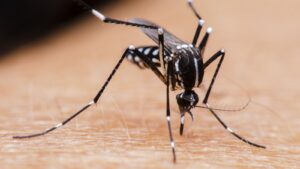
A lot of these programs target Aedes aegypti.
That species matters because it can transmit diseases like dengue, Zika, and chikungunya.
Aedes aegypti also behaves differently than the “woods and wetlands” mosquitoes people complain about at cookouts.
It’s a container breeder.
It likes human environments.
Bites often happen during the day.
Control strategies follow the biology.
That’s why you’ll see these biocontrol approaches described as targeted, precise, and species-specific.
Biocontrol Tool #1: Wolbachia-infected male mosquitoes
Wolbachia is a bacterium that naturally exists in lots of insect species.
It isn’t a new lab invention.
It’s part of nature.
Here’s the simple version.
A company raises male Aedes mosquitoes that carry a specific strain of Wolbachia.
Those males get released in a target area.
When a Wolbachia male mates with a wild female that doesn’t carry the right matching strain, the eggs don’t successfully produce viable offspring.
Less successful reproduction means fewer mosquitoes in the next generation.
Repeated releases keep that pressure on the population.
This approach is often described as the “incompatible insect technique.”
No genetic modification is required for this method.
What it’s good at
Wolbachia suppression is precise.
It targets a specific mosquito species.
Non-target insects don’t suddenly get wiped out.
Chemical pesticide use may also be reduced in places where these tools are deployed, depending on the program design.
What it needs to work
A steady release schedule matters.
Quality sex-sorting matters too, because females shouldn’t be released in a suppression program.
Monitoring matters as well.
Numbers have to be measured, not guessed.
Biocontrol Tool #2: Genetically modified male mosquitoes
This one gets the headlines.
People hear “genetically modified” and picture something out of control.
Here’s the real-world concept.
A company produces male Aedes aegypti that carry a genetic trait.
Those males are released and mate with wild females.
The trait is designed so female offspring don’t survive.
Male offspring can survive and carry the trait for a time, depending on the system.
Repeated releases keep pushing the local population lower because fewer females reach adulthood.
Oxitec’s OX5034 is a well-known example that has been evaluated under EPA experimental permits.
What it’s good at
This approach is also species-specific.
That’s a big deal for ecology.
Broad spraying can affect non-target insects if it isn’t done carefully and correctly.
Targeting one invasive species can lower disease-vector risk in places where that species is the problem.
What it needs to work
Community engagement matters.
Regulatory oversight matters too.
Monitoring is non-negotiable.
These aren’t “set it and forget it” programs.
Repeated releases and careful measurement are part of the design.
Where these tools have been tested and evaluated
This is where people ask, “Is this happening near me?”
Most of the talk you’ve heard has focused on Aedes aegypti work in places where that species is established and public health agencies want new options.
EPA has described experimental permitting for Oxitec’s OX5034 field testing in Monroe County, Florida and expansions that included multiple counties in California as part of evaluation and data-gathering.
EPA has also described Wolbachia-based products and registrations for Aedes control tools under pesticide regulation frameworks.
One important point belongs right here.
These programs are typically aimed at one mosquito species.
A typical backyard has several mosquito species using several breeding patterns.
That’s why your personal comfort plan still comes down to pressure, habitat, and consistency.
Species-specific is a big advantage, but it doesn’t answer every concern
I like tools that match the biology.
That’s where good mosquito control lives.
Species-specific control has real upsides.
Non-target organisms are less likely to be affected.
Pollinator risk can be easier to manage.
The “blast everything” approach becomes less attractive when precise tools exist.
Even so, good questions remain.
Question 1: How effective is it at real-world scale?
A lab result is not a neighborhood result.
Wind, microclimates, reinvasion from nearby areas, and human movement all change the outcome.
Programs need repeated releases.
Funding needs to stay consistent.
Monitoring needs to be transparent.
Question 2: What happens when the target population rebounds?
Mosquito populations refill.
That’s what they do.
Aedes can breed in tiny water sources.
A flowerpot saucer can do it.
A clogged gutters section can do it too.
Rebound pressure means the program has to be ongoing, or it has to be paired with aggressive source reduction.
Question 3: Could resistance or adaptation become an issue?
Nature pushes back.
That’s not a conspiracy.
It’s biology.
Long-term success depends on design, monitoring, and making changes when data says changes are needed.
Question 4: How should communities weigh ecology, ethics, and consent?
Some people will be all-in.
Others will want to see years of data first.
Public health programs work best when communication is clear, risks are addressed honestly, and people feel heard.
So what does this mean for your yard right now?
Most homeowners aren’t dealing with just one mosquito species.
Outdoor misery usually comes from a mix of mosquitoes, a mix of breeding sources, and a yard full of shady resting zones.
That’s why recurring barrier work still matters for comfort.
Consistency stays ahead of refill pressure.
Coverage targets the zones where mosquitoes hide and rest.
Our Mosquito + Tick Programs are built around that reality.
A steady program isn’t “extra.”
That schedule is the difference between a good week and a good season.
Breeding control matters too.
Standing water is the engine.
Larvae feed, so larvicides can control them.
Pupae don’t feed, so that stage can’t be controlled the same way.
That’s why Mosquito Egg & Larvae Control exists as a targeted add-on for tougher properties.
Five focused applications per season can help reduce breeding pressure in the places homeowners can’t always see or reach.
Bottom line
Wolbachia and genetically modified male mosquito releases are real tools.
They are designed to reduce certain mosquito populations in a targeted way.
Regulatory review and monitoring are part of the process.
A yard comfort plan still comes down to the basics.
Control the breeding.
Control the resting zones.
Repeat it on schedule so the yard doesn’t refill between visits.
That’s how outside stays fun.
FAQ
Are the male mosquitoes used in these programs going to bite my family?
A: No, the releases are designed around male mosquitoes, and male mosquitoes do not bite people.
Detail: Biting is a female behavior tied to egg production, which is why suppression programs focus on releasing males only.
Is Wolbachia the same thing as genetic modification?
A: No, Wolbachia is a naturally occurring bacterium used in a non-GMO approach to suppress target mosquito species.
Detail: The method works through reproductive incompatibility, which reduces viable offspring when infected males mate with certain wild females.
How do genetically modified male mosquitoes reduce the population?
A: The released males carry a trait that leads to female offspring not surviving, so fewer females emerge over time with repeated releases.
Detail: Population decline follows because females are the breeding engine, and fewer females means fewer eggs laid in the next cycle.
Will these technologies replace backyard mosquito spraying?
A: Not in most neighborhoods, because yard pressure usually involves multiple mosquito species and multiple habitat factors.
Detail: Species-specific biocontrol tools can be excellent for targeted public health objectives, while yard comfort still depends on coverage, schedule, and breeding reduction.
What should homeowners do right now to cut mosquito pressure?
A: A steady plan beats a one-time hit, especially during peak season when the yard refills fast.
Detail: Recurring barrier treatments plus standing-water control and targeted larvicide work on tougher properties is the practical path to better outdoor comfort.
Top towns we service
Here are 16 of the top towns we service every week.
Amesbury, MA
Andover, MA
Boxford, MA
Byfield, MA
Georgetown, MA
Groveland, MA
Haverhill, MA
Ipswich, MA
Merrimac, MA
Newbury, MA
Newburyport, MA
North Andover, MA
Rowley, MA
Salisbury, MA
Topsfield, MA
West Newbury, MA
Don’t see your town? See the full list here: Service Area
Related resources
Start with: Mosquito + Tick Programs
Add this for tougher yards: Mosquito Egg & Larvae Control
Ticks ONLY: Tick Control
Home protection: Home Shield
Stinging insects: Stinging Insect (MA)
Rodents: Rodent Control (MA)
Gutter Cleaning: Gutter Cleaning
Service Area: Service Area
Contact us: Contact us
Get Your Free Quote
Call or text: 888-229-0095
Email: jeff@mosquitoenemy.com | Contact us
It’s More Fun Outside! with Mosquito Enemy.