
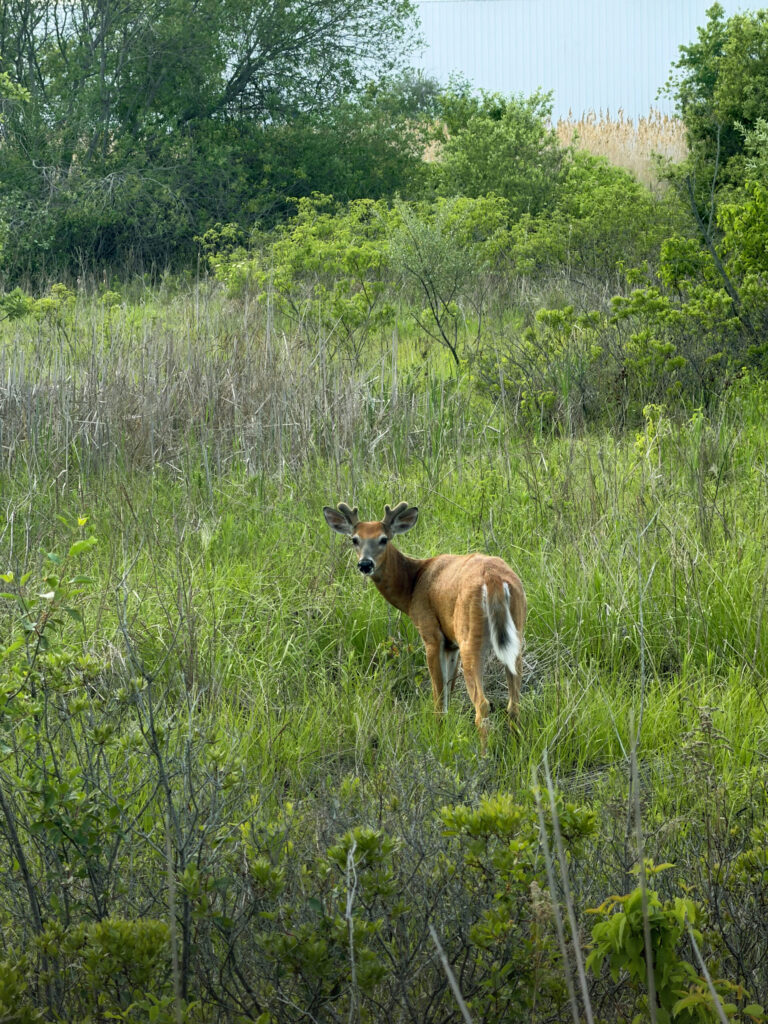
Hey, I’m Jeff, your local pest control guy. One question homeowners sometimes ask is whether deer fencing means the tick problem should be solved. From what I have seen in real yards, the answer is no: a deer fence can help, but it does not equal a tick-free property.
Deer matter because adult blacklegged ticks commonly use them as hosts, and a fed female tick can drop off after feeding. Keeping deer out may reduce one way ticks are introduced into a yard, while the fence can also protect shrubs and evergreens from browsing. But mice, chipmunks, birds, pets, and other wildlife can still move through or around many fences, and the habitat already inside the fence does not disappear.
A New Southern New England Study Makes This Even More Important
A 2025 study in the Journal of Medical Entomology looked at 16 deer-fenced and 16 unfenced residential properties in Connecticut, New York, and Rhode Island. Researchers found slightly fewer blacklegged ticks inside fenced properties overall, but the differences were not statistically significant, so the study did not provide strong evidence that deer fencing alone suppresses blacklegged ticks on smaller suburban properties. The southern New England residential study also found that landscape features such as stone walls and dense vegetation were associated with tick abundance.
In the field, that lines up with what I see. A homeowner can spend money keeping deer out and still have leaf litter, brush, stone walls, shaded beds, lawn-to-woods edges, and smaller wildlife moving around inside the fence. Those conditions can still support tick activity, which is why I treat deer exclusion as one part of an integrated prevention plan rather than the whole answer.
A Deer Fence Changes Deer Access, Not the Entire Tick Environment
Fencing can reduce deer traffic when it is installed and maintained well. Yet a normal residential fence does not seal the property against every host that can carry ticks. Mice and chipmunks can use stone walls, brushy edges, woodpiles, sheds, groundcover, and other protected areas, while birds and pets can move ticks from one place to another.
Cornell Integrated Pest Management makes the same point: deer fencing may reduce ticks, but it does not exclude smaller mammal hosts. That is why the important question is not only, ‘Do I have a fence?’ but also, ‘What tick habitat is still inside it?’
The Fence Line Itself Can Become a Maintenance Problem
Coming across a true deer fence is not common on every property we service, and the type of fence varies. Depending on how it was installed and maintained, leaves, weeds, vines, tall grass, and other debris can collect along the inside or outside edge. When that buildup creates a shaded, protected strip, I look at it the same way I would look at any other tick-prone habitat.
Good maintenance matters more than the name of the fence. Blow or rake accumulated leaves away, cut back heavy vegetation, prevent vines and grass from taking over the base, and use appropriate vegetation-control products only as their labels direct. The goal is not to create bare ground everywhere; it is to stop the fence line from becoming an unmanaged pocket of shade and organic debris.
Treatment Should Follow Habitat and Property Lines, Not Just the Fence
A fence does not automatically become the treatment line. If it sits along the normal perimeter and the surrounding habitat is part of the customer’s property, that edge may deserve treatment because of the vegetation and tick pressure there. However, a technician should not treat beyond the customer’s property simply because deer travel on the other side.
Site conditions control the decision. We look at wooded edges, stone walls, shaded vegetation, leaf buildup, wildlife movement, pet routes, and other areas where ticks are more likely to survive or where people and pets are more likely to encounter them. The fence is one clue, not the entire treatment plan.
Deer May Be Outside the Fence While Ticks Still Show Up Inside
Adult blacklegged ticks commonly feed on deer and then drop from their host after feeding. Fencing can reduce the chance of a deer walking through the middle of the yard, but it does not stop a tick from existing near the boundary, and smaller animals can transport ticks across or around the same fence.
I would not tell a homeowner that every tick found inside a fenced yard came from a deer on the other side. That would be impossible to prove. What I can say is that deer exclusion reduces one pathway while leaving several others in place, so continued tick sightings do not mean the fence has completely failed.
Deer Fencing Is IPM, Not a Guarantee
I look at deer fencing as one part of integrated pest management, or IPM. Done well, it can help reduce deer access, protect landscaping, and possibly reduce some tick introductions over time, but no single yard step guarantees zero ticks. Professional treatment does not guarantee zero ticks either.
The CDC specifically advises homeowners not to rely on pesticide treatment alone to reduce their risk of tick-borne infection. Habitat management, personal protection, pet protection, tick checks, and appropriate treatment all work better as layers than as one stand-alone fix.
Protect the People Using the Yard Too
Even with a fence and a professionally managed yard, people should still use personal tick precautions. Wear appropriate clothing in tick habitat, perform full-body tick checks after spending time outdoors, and use an EPA-registered repellent as directed. CDC guidance also recommends treating boots, clothing, and gear with 0.5% permethrin or using pretreated clothing. Important: permethrin should not be applied directly to skin.
That distinction matters because a yard program is about reducing exposure, not pretending exposure can never happen. If you are walking through brush, clearing leaves, working around a stone wall, or spending time outside the treated area, personal protection still matters.
A Deer Fence Can Still Be Worth Having
None of this means deer fencing is useless. Homeowners may install it to protect yews, shrubs, gardens, and evergreens from browsing, or to discourage deer from crossing certain parts of a property. Reducing deer access can also be a sensible tick-prevention measure when it is combined with the rest of the yard plan.
The mistake is expecting the fence to do a job it cannot do by itself. A well-maintained fenced yard can still have ticks, while a poorly maintained fence line can leave plenty of favorable habitat in place. Success comes from stacking practical steps rather than relying on one barrier.
What I Would Check on a Deer-Fenced Property
When I inspect a fenced property that is still having tick activity, I do not start by blaming the fence. I look at the yard itself: the lawn-to-woods transition, stone walls, leaf litter, brush, shaded plantings, pet-use areas, and places where wildlife can move or nest. Our earlier article on tick hot spots such as stone walls, leaf litter, and wood edges explains why those features deserve attention even when deer access has been reduced.
For wooded or pet-heavy properties, the same principle applies: reduce habitat where practical, protect the people and animals using the yard, and treat the areas that actually matter. You can read more about tick control for wooded yards and dogs if those are the conditions you are dealing with.
Deer Fencing Helps One Part of the Problem
A deer fence may reduce deer traffic and can be useful as part of an IPM plan. But it cannot remove the ticks already present, eliminate every smaller wildlife host, clean up leaf litter, dry out shaded habitat, or protect someone who walks into untreated brush. That is why I never use ‘deer fence’ and ‘no ticks’ as if they mean the same thing.
Look at the whole property instead. Keep the fence line maintained, reduce tick-friendly habitat, use personal and pet protection, and consider professional tick control when the property’s pressure and use justify it. The goal is lower exposure and fewer encounters, not a promise that nature can be reduced to zero.
Frequently Asked Questions
Q: Will a deer fence get rid of ticks in my yard?
A: No. Deer fencing may reduce deer access and can reduce one way ticks are brought onto a property, but mice, chipmunks, birds, pets, and existing tick habitat can remain inside the fence. Research published in 2025 on southern New England residential properties did not find a statistically significant overall reduction in blacklegged ticks on smaller fenced properties compared with unfenced properties.
Q: I fenced deer out. Why am I still finding ticks?
A: Ticks can remain because fencing does not remove leaf litter, brush, stone walls, shaded vegetation, or smaller wildlife hosts. Deer exclusion changes one part of the system, while the rest of the yard can still provide places for ticks to survive and opportunities for them to be moved around.
Q: Can mice and chipmunks bring ticks through a deer fence?
A: Yes. Deer fencing is designed to restrict deer, not to seal out small mammals. Mice, chipmunks, and other small wildlife can move through, under, or around many fences and can carry ticks into parts of the yard that deer do not enter.
Q: Should I treat the fence line for ticks?
A: Sometimes, but the fence itself is not the reason. If the fence line has leaf buildup, brush, vines, shaded vegetation, or other tick habitat on the customer’s property, it may deserve attention as part of the treatment plan. Property boundaries, site conditions, and the pesticide label still control where treatment belongs.
Q: Does deer fencing prevent Lyme disease?
A: No single yard measure can guarantee prevention of Lyme disease. Deer fencing can be one layer of tick-risk reduction, but CDC guidance still recommends personal protection, tick checks, habitat management, and appropriate use of repellents and other prevention measures.
Q: What else should I do if I already have a deer fence?
A: Keep leaves, weeds, vines, and brush from building up along the fence, manage other tick habitat around the yard, check people and pets for ticks, and use EPA-registered personal protection as directed. If you continue finding ticks or have significant tick habitat, professional tick control can be another layer in the plan.
Still Finding Ticks Even With a Deer Fence?
When deer are mostly staying out but ticks are still showing up around stone walls, wooded edges, shaded plantings, pet areas, or fence lines, Mosquito Enemy can help evaluate the rest of the property. Learn more about our professional tick control, Call or text: 888-229-0095 or contact Mosquito Enemy.
It’s More Fun Outside! with Mosquito Enemy.