
I’m Jeff, your local pest control guy.
If you live near tidal water, you’ve probably met salt marsh mosquitoes.
One minute the yard feels normal.
Next minute it feels “untreatable,” even when you’ve done everything right.
That frustrating swing is exactly why people start searching for mosquito control and wondering if any mosquito control service can actually keep up.
Good yards can feel impossible when the marsh hatches.
This post explains what salt marsh mosquitoes are, why they’re so aggressive, how far they travel, why they show up in waves, and what the best plan looks like for coastal and tidal neighborhoods.
Related reading
Rain after a mosquito treatment: what really happens
Why ticks keep getting worse in MA & NH
Quick answer
Salt marsh mosquitoes are coastal mosquitoes that breed in salty or brackish marsh habitat and can hatch in huge waves after high tides, heavy rain, or the right lunar-tide timing.
Their numbers can be intense, and they can travel far enough to make inland yards feel like the problem “came from nowhere.”
No company can erase the entire marsh source from a single backyard.
A professional plan can still make your yard usable by staying disciplined on schedule, focusing coverage where mosquitoes rest, and adding breeding-side help like mosquito egg and larvae control for the freshwater breeding pockets that exist on and around most homes.
What are salt marsh mosquitoes?
Most people think “a mosquito is a mosquito.”
Coastal life teaches you that’s not true.
Salt marsh mosquitoes are mosquitoes tied to marsh and tidal habitat, often breeding in salty or brackish environments instead of the typical freshwater spots we talk about at home.
One well-known example is the eastern salt marsh mosquito, Aedes sollicitans, which is widely recognized as a strong, aggressive biter and a long-distance traveler.
Another common salt-marsh mosquito, Aedes taeniorhynchus, is also known for long flight range and daytime biting when the opportunity is there.
These species are built for one thing.
They hatch fast, they bite hard, and they go looking for blood meals wherever they can find them.
Why are salt marsh mosquitoes so aggressive?
Aggressive usually means two things in real life.
Big numbers show up at once.
Daytime biting happens more than you expect.
Salt marsh mosquitoes are widely described as aggressive, and they can be a major nuisance when large hatches occur at the same time.
Mosquito-control programs also describe salt marsh mosquitoes as active during the day when disturbed, with heavy abundance after high tides or a combo of high tides and rain.
That’s why a quick “spray once and relax” mindset fails around the coast.
Pressure can go from mild to extreme in a single week, then back down again.
Nothing feels consistent because the marsh isn’t consistent.
How far can salt marsh mosquitoes travel?
This is the part that makes good yards feel “untreatable.”
You can have a clean property and still get slammed.
Travel range is the reason.
Some research in coastal systems describes typical flight activity in the few-mile range, which is still plenty to cross neighborhoods.
Other public mosquito-control sources describe much longer movement.
Some mosquito programs note flight range of more than 20 miles for Aedes sollicitans.
Other state mosquito resources describe the common salt marsh mosquito flying up to 40 miles from saltmarsh habitat in search of a host.
Education sources also describe Aedes sollicitans moving as far as 40 to 50 miles from breeding sites in search of blood meals.
A coastal New England mosquito management plan mentions salt marsh mosquitoes being capable of flying up to 25 miles, which is why coastal control can benefit inland communities too.
That range is why you can feel the hatch even if your house isn’t right on the water.
A fresh wave can roll inland and make your yard feel like it “stopped working.”
Why do marsh mosquitoes show up in waves, and sometimes during daylight?
Waves happen because their life cycle is tied to flooding patterns.
Eggs are laid in marsh zones that flood under the right conditions, then hatch when water reaches them.
Full moons and new moons matter because they drive higher tides, and those higher tides can trigger major hatches.
Many coastal resources note that big salt marsh mosquito hatches often occur within 7 to 10 days of a full or new moon.
Daytime biting shows up because these mosquitoes aren’t only “dusk bugs.”
Field descriptions for salt-marsh species include early morning and late afternoon biting, with daytime biting happening when resting females are disturbed or when an easy target appears.
Cloud cover and humidity can push daytime pressure higher too, especially in shaded yards that stay cool and damp.
That’s why a noon barbecue can feel brutal during a hatch week.
Can a mosquito company “stop” marsh mosquitoes, or is it damage control?
Let me be straight with you.
No single yard program can control the entire marsh source, because the source is regional.
That’s exactly why mosquito control in coastal areas often involves larger-scale monitoring and larval management by public mosquito programs.
Still, calling it “just damage control” isn’t fair either.
A good barrier program can make a huge difference in how many mosquitoes successfully land and feed in your treated zone.
The right goal is simple.
Make the yard usable again during the wave weeks.
Keep pressure low during the calmer stretches.
Stack the odds in your favor, even when the marsh is doing what the marsh does.
The best plan for coastal and tidal neighborhoods
Coastal yards need a plan that respects the wave pattern.
Smart timing beats random spraying.
Consistent coverage beats “more product.”
Schedule discipline is the foundation.
A premium mosquito control service runs on a schedule because mosquitoes refresh constantly.
Our synthetic program runs on a 21-day rhythm.
Our all-natural botanical program runs every 14 days.
Those intervals exist for a reason.
They keep your yard from falling behind when a hatch week hits.
Resting-zone coverage is where results come from.
Salt marsh mosquitoes still rest in shade and humidity pockets once they arrive inland.
Dense shrubs, under-deck zones, fence lines, and shaded borders act like “reset stations.”
A real mosquito and tick control visit targets those zones instead of painting the sunny lawn for show.
Breeding-side help still matters at the home level.
Marsh mosquitoes may be coming from the tidal source, but freshwater mosquitoes are usually breeding right on residential properties too.
Clogged gutters, low spots, tarps, toys, old planters, and damp edges can keep producing new adults all summer.
That’s where mosquito egg and larvae control earns its keep, using larvicides to target breeding areas and standing water pockets.
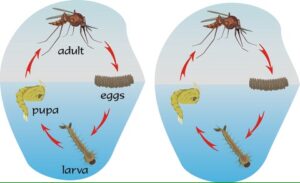
Mosquito Enemy is built around mosquito biology, and we focus on controlling 3 of the 4 life stages.
Pupae don’t feed, so they’re the one stage nobody controls through “feeding” action, and any company that says otherwise is selling you a story.
Weather protection belongs in the mix.
Coastal weather is messy.
Wind changes coverage.
Showers and irrigation change drying time.
Mosquito Enemy includes a Rain Shield additive in every application.
Rain Shield reduces water surface tension so product spreads evenly instead of beading up.
That same additive helps it bond faster and dry quicker for better coverage.
It also helps protect the application from rain or sprinklers and buys you real weather room, up to about 12 inches of rainfall or irrigation water before washout would be expected.
Quick showers after an application usually don’t mean it washed off.
Micro tactics help during hatch weeks.
Moving air is your friend.
Fans on a deck or patio reduce bites because mosquitoes struggle in steady airflow.
Timing outdoor time for breezier parts of the day can help too.
Long sleeves on wave days are not a fashion statement.
Comfort outside is the goal, so use every lever you’ve got.
Tick control still belongs in the conversation.
Coastal doesn’t mean tick-free.
Humidity and edge habitat also support ticks, which is why a true program looks at both pests together.
Standalone tick control exists for properties that need heavier tick focus.
Two outbound resources worth bookmarking
This National Park Service page talks about salt marsh mosquitoes and notes that large hatches often line up within 7 to 10 days of a full or new moon: NPS mosquito safety guidance.
This state mosquito resource also explains how far salt marsh mosquitoes can fly from their habitats, which helps explain why “perfect yards” still get hit: CT mosquito ecology overview.
FAQ
What are salt marsh mosquitoes, and why are they so aggressive?
A: Salt marsh mosquitoes are coastal mosquitoes tied to salty or brackish marsh habitat, and they can hatch in huge numbers at once.
Detail: Aggressive behavior comes from wave hatches and daytime biting, especially when big hatches line up with warm, humid weather.
How far can salt marsh mosquitoes travel from tidal areas into neighborhoods?
A: Travel distance can be surprisingly long, which is why inland neighborhoods can feel “invaded.”
Detail: Some sources describe typical travel in the few-mile range, while public mosquito programs and education resources describe long-distance movement that can reach 20+ miles and more.
Can a mosquito company “stop” marsh mosquitoes, or is it just damage control?
A: No single yard program can stop the entire marsh source, because it’s regional and driven by tides and flooding.
Detail: A strong barrier program can still make your yard usable by reducing successful landings and bites in treated resting zones during wave weeks.
Why do marsh mosquitoes show up in waves (and sometimes during daylight)?
A: Wave timing is tied to flooding and tidal cycles that trigger hatching in marsh zones.
Detail: Full and new moon tides can line up with big hatches, and daytime biting happens when resting females are disturbed or weather stays cool and humid.
What’s the best plan for coastal/tidal towns: barrier treatments, timing, or something else?
A: The best plan blends barrier treatments with smart timing and consistent schedule discipline through the wave season.
Detail: Add breeding-side control for freshwater pockets at home, keep resting-zone coverage tight, and use practical tools like fans during hatch weeks for real comfort outside.
Top towns we service
Here are 16 of the top towns we service every week.
Amesbury
Andover
Boxford
Byfield (Newbury)
Georgetown
Groveland
Haverhill
Ipswich
Merrimac
Newbury
Newburyport
North Andover
Rowley
Salisbury
Topsfield
West Newbury
Don’t see your town? You can find the full list here: Service Area.
Related resources
Start with Mosquito + Tick Programs
Add this for tougher yards: Mosquito Egg & Larvae Control
Ticks ONLY: Tick Control
Home protection: Home Shield
Stinging insects: Stinging Insect
Rodents: Rodent Control
Gutter Cleaning
Reach us: Contact us
Call/text: 888-229-0095 Email: jeff@mosquitoenemy.com Contact us
“It’s More Fun Outside”! with Mosquito Enemy.